Delete Negative Self-Talk Tweets & Replace with Confidence
Self-deprecating posts read differently to a stranger than they did to you. What to clear, and what to put there instead.
Why Delete Negative Self-Talk Tweets
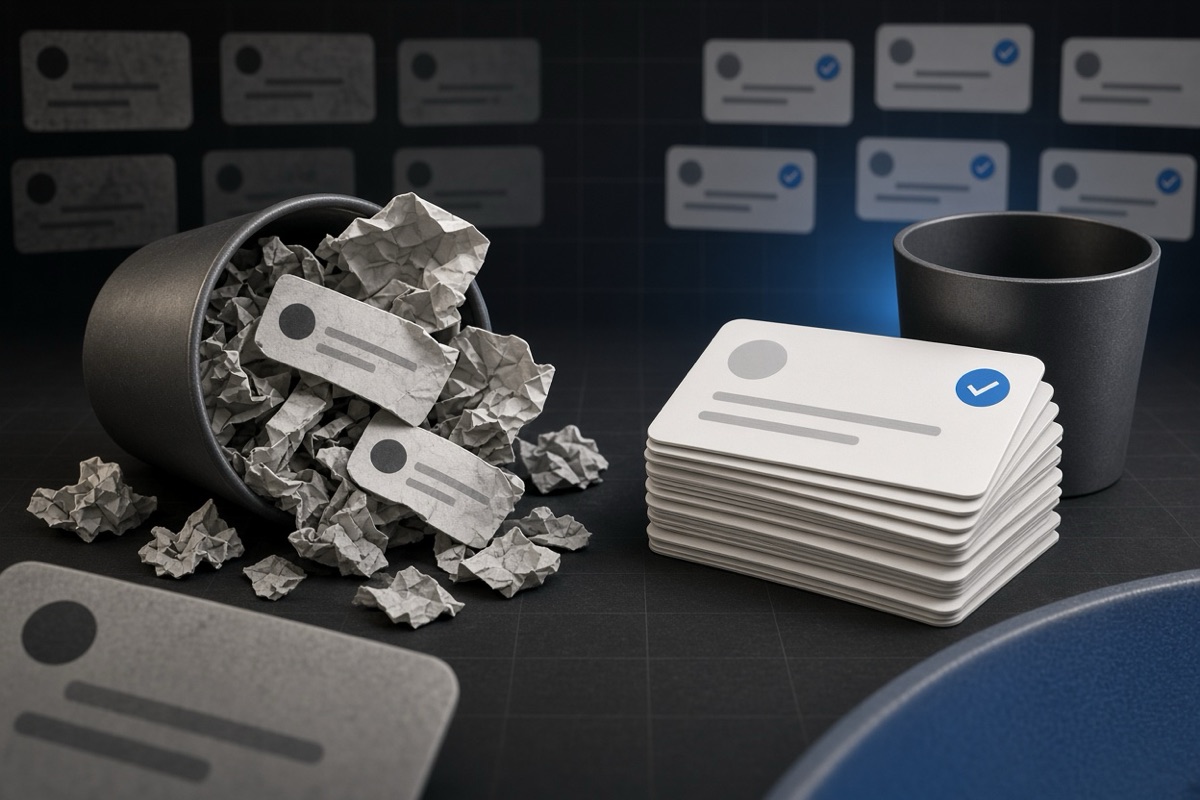
Your Twitter profile is an indication of how you feel about yourself, in public. Every self-deprecating tweet—writing that you are stupid, telling the world that you have bad judgment or claiming yourself worthless—is another one of these data points." When a recruiter, client or date is scrolling your timeline and sees a pattern of negativity they are not reading it as humour. They are reading it as truth. You erase those tweets, and you wipe off the evidence that saps away your confidence leaving only a clean slate for a more interesting tale.
Deleting is internal work, beyond the perception of the outside. Scientists refer to this as cognitive dissonance reduction: When you look back through your timeline full of criticising posts, your brain interprets that as evidence for the criticism being legitimate. You have to be breaking that cycle by deleting those tweets. You stop reinforcing the story that you are incapable or undeserving. The delete button is more than a rule — it is a mental health intervention that allows you to reset and create the narrative you choose.
Types of Tweets to Remove
Not all of self-deprecating tweets are created equal, but there is a clear structure among the kind that doesn t wipe more confidence off you. Remove Tweets that call your DUMBASS INTELLIGENCE OUT OF THE FSSHING PERIMETER, call you ugly (today), cannot carry a single TASK out of the MOU in question. Filter out tweets which have a sense of helplessness or hopelessness: "Nothing ever goes well for me" or "I always make the mistake." These are not true of reality or honest—you are practicing for a bad identity. Each one of these tweet is a mini-vote for you as this person you never wanted to be.
Sweeping them further by deleting tweets where you apologize way too much or blame yourself because of things beyond your control. The phrases "I apologise for being a burden" or "It is always my fault" radiate low self-worth to your readers while imprinting it back in your mind. No Futile Tweets: "I'm going to probably bomb this interview," or "This project will likely flop. These ain't harmless jokes—they are scripts your mind plays out. Just go out and get rid of them so the prophecy has no sustenance. We are not looking for deletion of honesty, but we want the language that makes self-criticism intractable to disappear.
How Self-Deprecation Affects Others
But when somebody new lands on your profile, they are looking to gather clues as to who you are. Your string of self-deprecating tweets says you are insecure. Employers see the phrase I am bad at this as a red flag. Your partner looks at you and thinks maybe they should say "of course not you are so hot" but instead think I don't want to lie, context. If your readers pick up on the idea that you always fail, they're going to think you're not capable of success. You cannot control the way people interpret your words, but at least, you can stop giving them ammo. Deleting the negative self-talk is not obscuring reality—it is preventing others from having an arsenal against you.
The perception issue is worse than you thought it was. People usually think that you say what you believe privately (which is not always so). If you tweet, "I am a absolute moron," a dozen times, they won't take if for a joke. They will assume you are either stupid or unable to self reflect. This is a type of bias referred to as the truth effect: statements that have been repeated are perceived to be more true than those presented for the first time. Your repeated tweets over time is what makes your brand. If that brand is self-deprecation, it keeps the opportunities and connections you want at bay.
What to Replace Them With
Once the negativity has been eradicated, replace with tweets that are authentically confident. This does not mean fake positive or braggadocio. That means acknowledging success, lessons and growth in tweets. Write about a project you completed, added a skill, or solved some problem. Talk about a mistake you've made, and what it taught you. Consider your frame failures as experiences, not proof of your ineptness. Something like "I screwed up the presentation but I asked nice questions afterwards" screams confidence so much more than something like "I suck at explaining things."
Authenticity does not require self-criticism. You can be truthful about what you are struggling with without name-calling. Instead of: "I am so lazy." Tweet: "I am working on my consistency scheduled." For "I am not good enough"; tweet "I have no talent" — instead say "im learning this new skill bit by bit". The contrast is mild but significant: one reinforces a static negative persona and the other signals momentum. Acknowledge every deleted tweet with a sentence that knows how to extend yourself the same courtesy you would have given your friend. And such curation changes how you perceive yourself internally and externally over time.
Removing by Date (Using TweetSweep)
TweetSweep allows you to delete your tweets from a certain date — the easiest way to purge years of negative self-talk. Open up the tool and plug in the start date from when your path to self-deprecation started, all the way through today. Click delete. The tool can process up to 50 tweets every 15 minutes, clearing an average backlog in just a few hours. You do not have to read every tweet. You know the drill: if it insults you, in it goes. Your date-range approach captures tweets you missed and keeps you from second guessing each post.
The other operation is to check preview using the bulk delete; mark any of those negative tweets by date out of your release window In some cases a lone self-critical tweet from months earlier passed under the radar because it was outside the range. Delete those individually. Next, look at your profile for the tone of voice. They aspire to a CV that project, -to anyone looking at it who isn't already predisposed to be impressed-, competence and self respect not self doubt! TweetSweep does, however, let you archive deleted tweets (you're just creating a private backup), but you'd be better off deleting it rather than hiding something if you're trying to rebuild your confidence. Out of sight, out of mind — and out of your neural loops.
The Psychological Ripple of Curation
The magic of curating your profile toward confidence is that it alters not only public perception, but perhaps less dramatically, the wiring in your own brain. Every deleted negative tweet is a removal of a reminder for past self-hate With each new positive tweet, we are laying an anchor of self-esteem. Over the weeks, your timeline documents success and progress rather than a museum of insecurities. This matters because Twitter observes this behavior and treats even your postings as evidence. Your internal monologue changes from "I suck at this" to "I completed that project. You begin to trust this new narrative.
It even ripples through how you relate to others. A confident profile gets confident replies. The replies are supportive and collaborative rather than pitying or gleeful, like in a schadenfreude. You stop feeding victim story and you start creating growth narrative. The process of deleting and replacing slowly became self-respect. You are not faking it till you make it. You are just not allowing social media to be a means of harming yourself. Twitter also helps you to be the person you want to be—one tweet at a time; your Twitter profile becomes a means of getting there.